shifnal-british-workman
Shifnal people: the British Workman
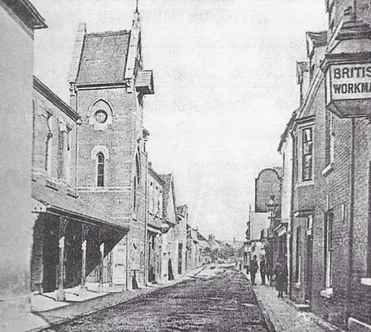
The sign ‘British Workman’ can be seen on the side of the building, now Jackson’s the butchers, on the corner of Aston Street and Bradford Street, and some decorative tiles of the lecture room survive in the Gallery in Aston Street. The British Workman was officially opened by John Howard McLean, of Aston Hall, on 27th March 1874 as a public house without alcoholic drinks. Mr. and Mrs Howard McLean, staunch Methodists and strict tee-totallers, bore the whole cost of the purchase of the building and continued to meet the running expenses for many years. As well as providing refreshments, there was also a reading room, supplied with newspapers by Mrs Howard-McLean and a lecture room at the rear where temperance meetings took place from time to time. This room was also used for town meetings, such as to organise local festivities and during the First World War as a recruiting centre.
The main purpose of the British Workman was to combat the problem of drunkenness in Shifnal. Mid-century Shifnal offered a choice of 16 pubs and 6 beer sellers who could not sell spirits. Drunkenness in Shifnal was so common that the Shrewsbury Chronicle commented one week in 1871 on the fact that there were no cases of insobriety at the petty sessions. In December 1878 a major mission was held in Shifnal with meetings for the promotion of temperance and services at the Wesleyan, Zion Baptists and Primitive Methodist chapels. There was a public meeting at the British Workman and the children of the Band of Hope sang songs. ‘The mission was successful due to the labours and liberal help of the Howard-McLean’s who are untiring in their efforts to morally and spiritually benefit the town’. Co-inciding with a severe winter, during which there was much distress in the town, perhaps the success was also due to the free coal distributed by Miss Howard McLean to those attending the Temperance Mission.
In January 1881, Mr and Mrs Howard McLean engaged Samuel Berry, described as a ‘home missionary’ to manage the British Workman. His diary of his experiences in Shifnal is lodged at Shropshire Archives. At first, attendance at meetings was disappointing until he introduced a new sort of meeting with singing, recitations and short talks instead of long lectures and he was soon reporting on packed audiences. He held open-air meetings in the summer and also visited people at home, preferring to arrive in the evening when they could not see him coming and prepare for his visit.
Samuel Berry left Shifnal in 1883 and the work to promote temperance continued with the establishment of the Shifnal Temperance League, supported of course by the Howard McLeans. The Band of Hope continued to meet at the British Workman, hoping to influence parents through their children, but this organisation is also remembered as fun to belong with treats and picnics at Aston Hall for faithful members.
From the late 19th century there was a decline in consumption per head nationally—associated with the temperance movement, the encouragement of employers who needed a sober workforce and leisure facilities such as bands, mechanics institutes, horticultural societies, sport and places to meet like the British Workman. Well into the 20th century the British Workman invited you in with a notice on the window declaring:-
‘A public house without the drink, where men can sit, talk, read and think and safely home return’.
At the Local History Exhibition in the Fire Station, Shrewsbury Road, there is a display about the British Workman, featuring a token which could be exchanged for food and bears the inscription ‘GOOD FOR ONE PENNYWORTH OF FOOD’. Why not pop in and see it? The Fire Station is open every Friday, 2 – 4pm and Saturday, 10 – noon.
Share your Shifnal history
We love to hear from people with stories that are worth sharing – get in touch and send yours.