Share
Share
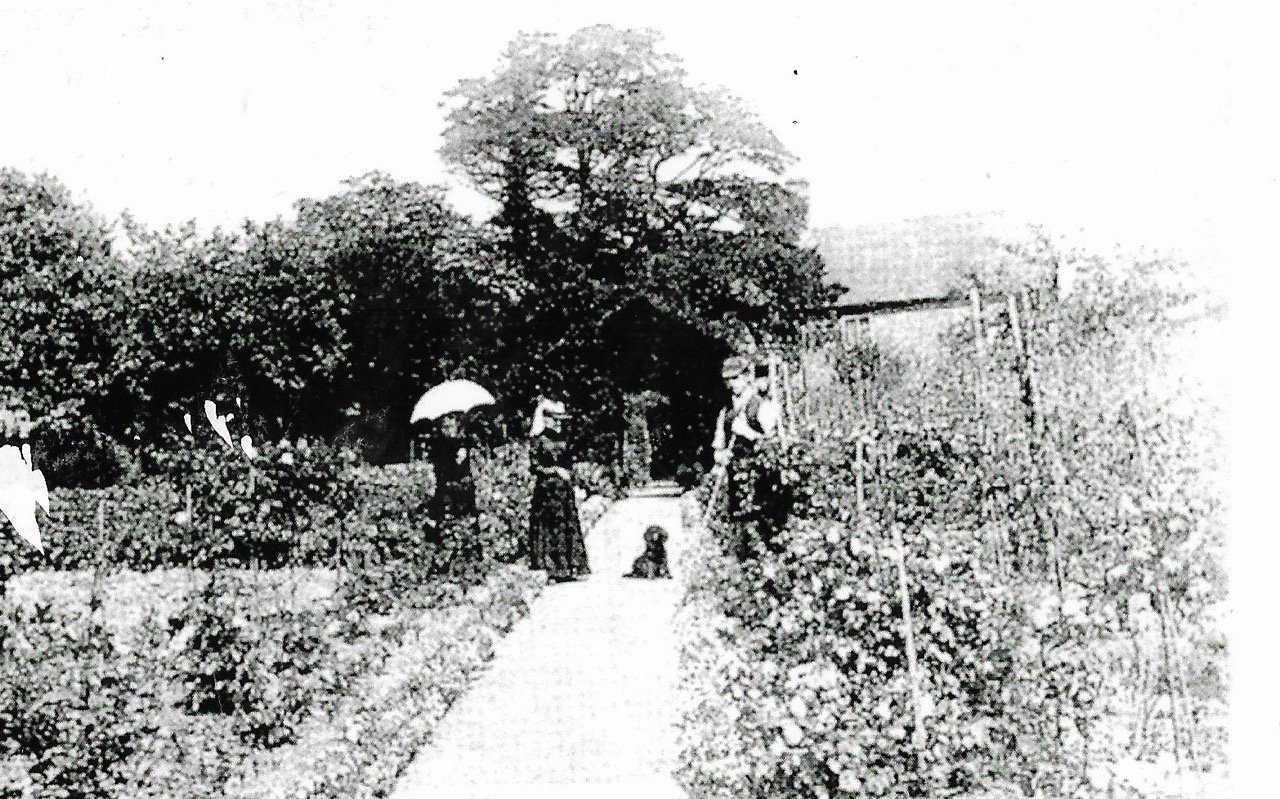
Shifnal Cottage hospital gardens
The garden at the Shifnal Cottage hospital in Park Street
Shifnal people: gardeners
This photograph shows the garden at the Shifnal Cottage hospital in Park Street – where Dyas Close now stands – and dates back to pre- First World War. It is not clear enough to identify what is being grown but possible the garden had a dual purpose, as a place of exercise for the patients and a source of home grown vegetables. The man with the hoe is obviously the gardener and perhaps the women are nurses or visiting benefactresses?
Although we cannot identify this man, or the women, through the local censuses, we can trace the men who were employed as gardeners in Shifnal and the surrounding estates. From their addresses we can work out where they lived. For example, in the 1901 census, the team working on the Deckerhill Estate comprised Sam Fellows at Top Lodge, Alf Beamand at Drayton Lodge, and John Barnett and Edward Jones in Deckerhill Cottages. William Mason, Thomas Reeves and William Taylor all lived in cottages on the Haughton Hall Estate. These were expert gardeners and groundsmen, but there were also garden labourers living in Shifnal, possibly working whether the work was to be found.
During the 19th century there was a national movement to encourage general workers to take up gardening as an alternative to visits to the pub and also to supplement the family diet. To encourage this interest, Horticultural Societies were set up and annual shows were organised. Shifnal Cottagers Horticultural Society was formed in the 1860s: it was celebrating its 22nd annual show in 1888. The shows were usually held in August or early September on the Cricket Field and or in the grounds of Aston Hall. A newspaper report for the show held in August 1884 relates that there were two classes of prizes: Class A for professional gardeners working in gentlemen’s gardens and Class B for amateur gardeners working on their own plots. There were prizes for many sorts of vegetables and herbs, fruit and flowers. Class C was also for cottagers with prizes for honey, bread, cooked potatoes, best kept garden and hedges and prizes for sewn and knitted items. Finally there were prizes for children. The Flower Show was also an opportunity for the professional gardeners to show off the exotic blooms grown in the greenhouses of the local estates.
The Horticultural Show seems to have got bigger each year. Ten years later, in the newspaper report for the show in August 1894, it was reported that ‘There has been an increasing attendance each year because of the new amusements introduced. There was strong competition in the horticultural section. Mrs Horton sent a very fine collection of plants for exhibition… as did W. Perrot (Priorslee Hall), Rev. Garnett Botfield (Decker Hill) and J. T. Brooke (Haughton Hall). J. T. Brooke also contributed good specimens of grapes, peaches and apricots. Mrs Kenyon Slaney (Hatton Grange) exhibited a brilliant display of greenhouse plants. In addition to the floral exhibition there was also an excellent programme of athletic sports and competitions for the yeomanry and a sale of work for the church organ fund. There was a brass band contest and other amusements’.
The last report on the Society, traced so far, relates to the AGM held in January 1905. Like so many other institutions and events, the Society and its wonderful show were killed by the First World War. The information for this story has been gleaned from an index to articles about Shifnal in the ‘Shrewsbury Chronicle and Wellington News’, created by members of the Shifnal St. Andrew’s Archive Group, the former name of the Shifnal Local History Group.